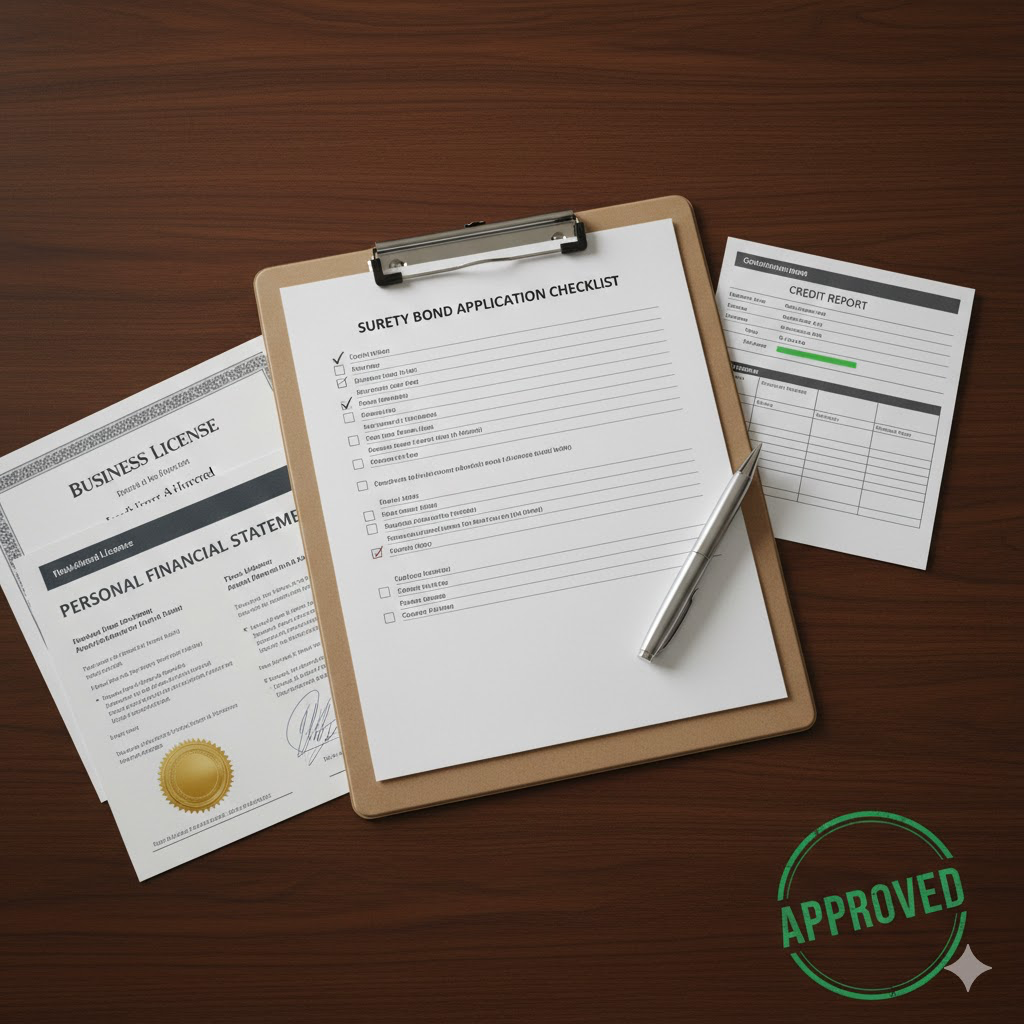
Most People Who Get Denied for a Surety Bond Made the Same Mistake — They Applied Without Knowing What Surety Companies Actually Look For
A contractor in Ohio applies for a $250,000 performance bond and gets denied — not because his credit is bad, but because he submitted his own financial statements when the bond amount required CPA-prepared documents. A collection agency in Texas applies for a license bond without knowing that every owner with more than 10% stake in the company needed to be disclosed. A first-time notary public in Florida sends in her application before confirming the required bond amount with her state licensing office. Three very different people, three very different bond types — all denied for the same root cause: they didn’t know what surety companies look for before they applied. This guide changes that. Whether you’re a contractor pursuing your first performance bond, a business owner seeking a license bond, or a new professional meeting a state bonding requirement, here is exactly what qualifies you, what documents you need, what factors drive your cost, and what to do if your first application doesn’t succeed.
What Surety Companies Are Actually Evaluating
When a surety company reviews your bond application, they are not behaving like an insurance company calculating the probability of a payout they expect to absorb. They are behaving like a lender evaluating whether to extend credit — because that is structurally what a surety bond is. When they issue your bond and you fail to perform, they pay the claim and then come to you for every dollar back, plus investigation costs and interest under the personal indemnity agreement you signed. Their underwriting is designed to minimize the likelihood that this chain of events ever occurs.
The surety industry organizes its qualification evaluation around three core factors known throughout the industry as the Three Cs: Character, Capacity, and Capital.
Character is the surety’s assessment of your professional reputation, business ethics, and track record. Prior claims on previous bonds, criminal convictions, license revocations, regulatory violations, and professional disciplinary history all speak to character. A contractor who completed 50 projects without dispute demonstrates character. An applicant with two prior bond claims and a suspended license raises serious character concerns.
Capacity is the surety’s assessment of your ability to actually perform what you’re bonded to do. For contractors, this means your workforce size, equipment assets, subcontractor relationships, completed project history, and technical expertise. For licensed professionals, this means your years of industry experience, relevant credentials, professional training, and demonstrated competence in your field. The surety is asking: can this person or business actually do what they’re promising to do?
Capital is the surety’s assessment of your financial strength. This includes personal credit score, business financial statements, personal net worth, liquidity, assets relative to liabilities, and business profitability. For large bonds, capital evaluation becomes significantly more rigorous — and significantly more document-intensive.
Every underwriting decision traces back to these three factors. Understanding which ones you excel at — and which ones need strengthening — is the foundation of a successful bond application.
The Two Application Pathways: Instant Issue vs. Underwritten
Not every bond requires deep underwriting. The surety industry has developed two distinct application pathways that determine how much qualification scrutiny you’ll face.
Instant Issue Bonds are available with no credit check. Everyone qualifies at the same price, and the premium is fixed regardless of applicant profile. Applications typically require only basic identifying information needed to complete the bond form. Many standard license and permit bonds — including notary bonds, process server bonds, security guard bonds, and various small-amount professional bonds — issue this way. If you’re applying for a bond type that appears on an instant issue list, your qualification process is simply completing the form accurately and paying the premium.
Underwritten Bonds require a soft credit check and may have specific eligibility requirements based on the bond type, amount, and applicant profile. The soft credit check does not affect your credit score — it is an inquiry that appears only on your personal record, not one visible to future lenders. Underwritten bonds may also require additional documentation beyond basic business information. Large construction bonds, high-value license bonds, and any bond where the obligee requires full financial review fall into this category. The larger the bond amount and the higher the risk classification of your industry, the more rigorous the underwriting process.
Surety Bond Qualification Requirements by Bond Type
License and Permit Bonds
The majority of license and permit bonds for amounts under $50,000 issue with minimal qualification scrutiny. Underwriters conduct a soft credit check and verify years of business experience, then issue a quote based on these two factors. For bonds over $50,000, expect to provide both business and personal financial statements. For the most common bond types in this category, you will need to disclose every owner holding 10% or more stake in the company — not just the primary applicant. Missing this disclosure triggers rejection even when all other information is correct.
Standard information required across all license and permit bond applications includes your professional license number, business name and any DBA, business location, business structure (sole proprietorship, LLC, partnership, corporation), and industry-specific details that vary by state and bond type.
Construction and Contract Bonds
Contract bond qualification is the most document-intensive in the surety industry. The threshold for required financial documentation scales with the bond amount.
Construction Bond Financial Document Thresholds
| Bond Amount | Financial Statement Required | Prepared By |
|---|---|---|
| Under $500,000 | May not be required | Applicant |
| $500,000 – $2,000,000 | Business and personal financial statements | Applicant acceptable |
| Over $2,000,000 | Business and personal financial statements | CPA-prepared required |
Beyond financial documents, construction bond underwriting typically requires the scope and timeline of current active projects, an insurance certificate showing general liability and workers’ compensation coverage, number of employees, a bank reference letter, a completed project list specifying project length and total cost, copies of past contracts, the business operating agreement or articles of incorporation, and a work in progress schedule outlining the project timeline.
Contractors are also evaluated on two separate capacity thresholds: their single limit (the maximum bond amount for any one project) and their aggregate limit (the total bonding capacity across all active projects simultaneously). A contractor approved for a $2 million single limit may be ineligible for a new $500,000 bond if their aggregate capacity is already fully committed on other projects.
Vehicle Title Bonds
Vehicle title bonds — required when a vehicle title is lost, damaged, or never received — are always issued instantly with no underwriting. However, you must contact your state DMV and receive written confirmation that a bonded title is your correct pathway before a surety company will issue the bond. Attempting to apply before receiving this obligee confirmation is the leading cause of lost title bond application failure. The required bond amount is based on the appraised value of the vehicle per your specific DMV’s formula — confirm the exact amount before applying rather than estimating.
Probate and Fiduciary Bonds
Probate and court bond qualification requires court-specific documentation that varies by bond type and state. The information required includes the case number, obligee name and address, details about the court case and any disputes among heirs, the estate owner’s name and date of death for administrator and executor bonds, a complete list of the estate’s assets, a copy of the deceased’s will for executor and administrator bonds, and documents detailing the person’s financial assets for conservatorship bonds.
A critical warning that most guides omit: underestimating the estate value when applying for a probate bond has severe consequences. If your bond amount is set too low, increasing it later requires a court order — a time-consuming and expensive legal process. Worse, the applicant may not qualify for the higher bond amount needed, rendering the original bond useless. Confirm estate valuation through formal appraisal before applying for any probate bond.
Business Service and Fidelity Bonds
Business service and janitorial bonds issue instantly with no credit check. Required information is minimal: company name, company address, desired bond amount, number of employees, and the type of work your company performs. ERISA fidelity bonds for employee benefit plans follow federal qualification standards set by the Department of Labor rather than state licensing requirements.
What Qualification Looks Like by Credit Profile
Credit score is not a disqualifier for most surety bonds. The surety industry operates on near-universal approval — more than 99% of bond applicants receive coverage regardless of credit history. What credit affects is the cost of your bond, not whether you can obtain it.
Surety Bond Cost by Credit Score (Typical Ranges)
| Credit Profile | Score Range | Premium Rate | Notes |
|---|---|---|---|
| Excellent | 700+ | 1% – 2% | Best available market rates |
| Good | 650 – 699 | 2% – 3% | Standard underwritten rates |
| Fair | 600 – 649 | 3% – 5% | May require financial docs |
| Poor / Challenged | Below 600 | 5% – 15% | Non-standard market; still approved |
| Instant Issue Bonds | Any | Fixed flat rate | No credit evaluation |
Applicants with challenged credit can improve their qualification outcome by providing strong financial records even when not required, demonstrating years of industry experience, offering collateral in some cases, adding a cosigner with stronger credit as a co-principal, and shopping multiple surety providers — rates in the non-standard market vary significantly between providers.
The SBA Surety Bond Guarantee Program: The Alternative Most Guides Never Mention
The U.S. Small Business Administration operates a Surety Bond Guarantee (SBG) Program that helps small businesses obtain contract bonds they cannot qualify for through the standard commercial surety market. If you have been denied a bid bond, performance bond, payment bond, or maintenance bond due to credit challenges or insufficient bonding history, the SBA program may be your pathway to qualification.
The SBA guarantees contract bonds — not commercial license bonds — for qualifying small businesses. Contract amounts are capped at $9 million for non-federal projects and $14 million for federal government contracts. To qualify for SBA-backed bonding, your business must meet SBA size standards for your industry, your contract must fall within the program’s dollar limits, and you must still meet the surety company’s credit, capacity, and character standards — though these are applied more flexibly under the SBA guarantee structure.
The SBA operates two guarantee programs: the Prior Approval program, where SBA reviews each bond individually, and the Preferred Surety Bond (PSB) program, where approved surety companies can issue SBA-guaranteed bonds without case-by-case SBA review. Contact suretybonds@sba.gov or review the SBA’s database of approved guarantee surety agencies to find providers near you.
When the Obligee Matters More Than You Think
The single most common pre-application mistake is purchasing a bond before confirming exact requirements with the obligee — the agency, court, or entity requiring the bond. Bond amounts, required forms, and specific obligee names vary not just by state but by county and municipality. Using the wrong form causes rejection even when the bond amount and applicant qualifications are perfect. Downloading bond forms from any source more than a few weeks old risks submitting an outdated version.
Before purchasing any surety bond, contact the requiring obligee and confirm the exact bond amount, the exact obligee name as it must appear on the bond form, the current bond form version, and the filing method they accept. For underwritten bonds requiring significant documentation, start this conversation several weeks before your license application deadline.
How to Get Bonded: Step by Step
Step 1: Confirm your bond requirement with the obligee. Identify the exact bond type, amount, required form, obligee name, and filing deadline before anything else.
Step 2: Gather your qualification documents. For instant issue bonds, this is simply business information. For underwritten bonds under $500,000, have your financial statements and professional history ready. For bonds over $500,000, engage a CPA to prepare your business financial statements before applying. For bonds over $2 million, CPA-prepared financials are non-negotiable.
Step 3: Apply with multiple licensed surety providers. Get three to five quotes, especially for underwritten bonds. Premium rates in the non-standard market (poor credit applicants) vary substantially between providers. Soft credit checks from multiple providers within a short window do not compound their effect on your credit score.
Step 4: Review your indemnity agreement before signing. The bond certificate is the document filed with your obligee. The indemnity agreement is the document that binds you to repay the surety for any claims paid on your behalf, including investigation costs and interest. Read both carefully. The indemnity agreement is often signed quickly and forgotten — until a claim makes its consequences real.
Step 5: File with the correct obligee using their exact method. Some obligees accept digital bonds. Others require originals with wet signatures and surety company seals. NMLS-coordinated mortgage bonds file through the NMLS portal. Courts require bonds filed with the specific court clerk. Confirm the exact filing method before submitting your bond documents.
Step 6: Track your renewal date separately from your license renewal date. Bond and license renewal cycles frequently misalign. A lapsed bond — even by a single day in strict states — can trigger immediate license suspension requiring formal reinstatement before resuming operations.
How Business Entity Type Affects Your Qualification
The structure of your business directly affects how surety underwriters evaluate your application. Sole proprietors have their personal and business finances treated as indistinguishable — your personal credit and net worth are the entire financial picture. This simplifies underwriting but also means personal financial problems have direct bond qualification consequences.
LLC and corporation applicants are evaluated on both business financials and personal financials of all qualifying owners. The 10% ownership disclosure requirement applies here — all owners above this threshold must be included in the application and may each be subject to credit evaluation. A business with one owner who has excellent credit and a second owner with severe financial problems may face complications that the primary owner never anticipated.
Joint ventures and partnerships bonding for construction projects face the most complex qualification requirements, as the surety evaluates the combined financial capacity, combined experience, and shared indemnity exposure of all participating entities.
How Surety Companies Themselves Qualify: Why It Matters to You
Not every company that offers to sell you a surety bond is qualified to do so. Surety companies issuing federal bonds must hold a Treasury Department Certificate of Authority under 31 U.S.C. 9304-9308, granted through the Bureau of the Fiscal Service. Companies issuing bonds in individual states must hold that state’s Certificate of Authority from the state insurance department. Department Circular 570 is the official Treasury list of companies certified to write federal surety bonds.
Before purchasing any surety bond, verify that your provider holds the appropriate state license. For federal contract bonds and bonds required by federal agencies (Medicare/Medicaid, Customs, Immigrant bonds, Excise bonds, and Alcoholic Beverage bonds), verify Treasury certification. An improperly issued bond from an unlicensed provider is not a valid bond — your obligee will reject it and you’ll have no legal protection.
Frequently Asked Questions About Surety Bond Qualifications
What credit score do I need to qualify for a surety bond? There is no minimum credit score for surety bond qualification. Virtually all applicants — including those with scores below 600 — can obtain surety bonds. Credit score determines the cost of your bond, not your eligibility for one. Applicants with scores above 700 typically pay 1%–2% of the bond amount annually. Applicants below 600 may pay 5%–15% through non-standard surety markets. Instant issue bonds like notary bonds, security guard bonds, and vehicle title bonds carry fixed flat-rate premiums with no credit evaluation whatsoever.
Does applying for multiple surety bond quotes hurt my credit score? No. Surety companies conduct soft credit inquiries — also called soft pulls — that do not appear on your credit report as visible to future lenders and do not affect your credit score. You can shop as many surety providers as you like without any credit impact. This is explicitly different from hard credit inquiries done by mortgage lenders, auto dealers, and credit card issuers.
What happens if I have a prior bond claim on my record? Prior claims are recorded in the Surety Information Office (SIO) database and remain accessible to surety underwriters for seven to ten years. A prior claim flags your application for closer scrutiny and typically increases your premium rate. Multiple prior claims may narrow your options to specialized non-standard markets. A prior claim does not automatically disqualify you from future bonding — but full disclosure is required. Concealing prior claims in a bond application is grounds for immediate bond cancellation when discovered and may expose you to fraud liability.
Do I need to be a U.S. citizen to qualify for a surety bond? U.S. citizenship is not required for most commercial surety bonds. Legal authorization to conduct business in the United States — including proper business registration, licenses, and taxpayer identification — is typically sufficient. Non-residents and foreign nationals applying for bonds in states where they conduct licensed business generally qualify under the same standards as U.S. citizens. Federal bonds and some specialized bond types may have additional requirements for non-U.S. entities — confirm with the specific obligee and your surety provider.
How long does surety bond underwriting take? Instant issue bonds purchase and deliver within minutes online, 24 hours a day. Standard underwritten license bonds with soft credit check typically return quotes within hours and can be purchased and issued same-day. Larger bonds requiring full financial statement review — particularly construction performance bonds, mortgage license bonds, and collection agency bonds — typically take one to three business days. Bonds requiring CPA-prepared financial statements take as long as it takes to get those documents prepared, which can be two to four weeks if you haven’t started. Court and probate bonds requiring specific court documents follow the court’s timeline for providing those documents.
What is aggregate bond capacity and why does it matter for contractors? Aggregate bond capacity is the total value of all bonds a surety company will issue to a single contractor across all active projects simultaneously. A contractor approved for a $5 million aggregate capacity who currently has $4.5 million in active bonded projects has only $500,000 of aggregate capacity remaining — regardless of their single limit. Contractors who work multiple simultaneous projects must monitor their aggregate capacity at all times to ensure they can bond new work as it comes available. Surety companies increase aggregate capacity as contractors build track records of successful project completion.
Can an LLC with bad credit qualify for a surety bond? Yes, with the understanding that both the LLC’s business financials and the personal credit of all owners with 10% or more ownership will be evaluated. If the LLC itself has limited financial history — common for new businesses — the personal financial profile of the owners becomes the primary qualification basis. An LLC with a financially strong owner who has good personal credit typically qualifies at favorable rates even if the business is newly established. Conversely, an LLC with multiple owners where one has serious credit problems may face complications beyond what the primary owner’s credit alone would suggest. Disclosing all qualifying owners is mandatory and non-negotiable.
What does it mean to add a cosigner to a surety bond application? Adding a cosigner — technically a co-indemnitor — means another financially qualified individual or entity agrees to share liability for any claims paid under the bond. The cosigner’s credit and financial strength are evaluated alongside the primary applicant’s, potentially improving the qualification outcome or reducing the premium rate. Cosigners bear real financial exposure: if a claim is paid, the surety can seek reimbursement from the cosigner as well as the primary applicant. This is not a nominal commitment — cosigners should fully understand their financial exposure before signing.
Do surety bond renewals require re-qualification? Yes. Most surety companies conduct a soft credit review and may request updated financial information at renewal. If your financial situation has improved since your original qualification, renewal is an opportunity to negotiate a lower premium. If your financial situation has worsened, expect your renewal rate to reflect that change. Contractors whose bonding history is strong — projects completed without claims, financial growth demonstrated — typically earn improved aggregate capacity and lower rates at renewal. The renewal process is generally faster than initial qualification since your provider already has your background information.
What is the difference between the SBA’s Prior Approval and PSB programs? The SBA Surety Bond Guarantee program operates through two tracks. Under Prior Approval, the SBA reviews each bond application individually before issuing its guarantee — adding processing time but allowing review of complex or borderline applications. Under the Preferred Surety Bond (PSB) program, SBA-approved surety companies are authorized to issue SBA-guaranteed bonds without case-by-case SBA review, making the process significantly faster. PSB program surety companies carry pre-delegated authority up to their approved limits. For small contractors needing bonds quickly, identifying a PSB-authorized surety company is the fastest pathway to SBA-guaranteed bonding.
The Bottom Line on Surety Bond Qualifications
Qualifying for a surety bond is not the obstacle most applicants fear. The surety industry approves over 99% of applicants regardless of credit history, financial challenges, or industry experience — because surety bonds are structured as credit instruments backed by personal indemnity, not insurance policies absorbing expected losses. What matters is that you approach qualification prepared: knowing your bond type, understanding which of the Three Cs your profile excels at and which needs supporting documentation, gathering the right financial documents before applying, confirming your exact requirements with your obligee, and shopping multiple licensed providers for the best available rate.
The applicants who get denied are almost always the ones who applied without knowing what the surety company needed to see. The ones who succeed are the ones who read exactly what you just read.
5 Fascinating Facts About Surety Bond Qualifications Not Found in Any Top-Ranking Website
Surety underwriters use a little-known scoring tool called a “contractor questionnaire” that evaluates up to 47 distinct factors simultaneously — including the ratio of receivables to current liabilities, the percentage of work self-performed vs. subcontracted, and the geographic dispersion of active projects — making surety underwriting statistically more complex than most commercial lending decisions. This multi-factor scoring model was developed over decades by actuaries studying construction project default patterns and is proprietary to each surety company. Two contractors with identical credit scores and financial statements can receive dramatically different qualification outcomes based entirely on how their questionnaire responses score against the surety’s internal risk model. This is why shopping multiple surety providers produces meaningfully different results — not because providers are arbitrarily inconsistent, but because each company’s proprietary scoring model weighs the 47 factors differently based on their own claims history.
The qualification standard for surety bonds in the United States traces directly to medieval English law — specifically to the English Statute of Frauds of 1677, which required that any promise to answer for the debt, default, or miscarriage of another person must be in writing to be legally enforceable. This statute is why surety bonds must always be written documents with specific parties identified — the principal, the obligee, and the surety — rather than oral agreements. Modern U.S. surety underwriting qualification standards evolved from the same legal framework that required 17th-century English merchants to document their financial guarantees in writing before courts would enforce them. The Three Cs of qualification (Character, Capacity, Capital) themselves descended from the character evaluation that English courts used to determine whether a medieval surety’s promise was credible enough to enforce.
One of the least-known surety bond qualification pathways in the United States is the “deed of trust” alternative, where applicants in some Western states — particularly California, Oregon, and Nevada — can satisfy certain bonding requirements by pledging real property as collateral through a deed of trust recorded against the property instead of purchasing a traditional surety bond from an insurance company. This alternative exists because the legal function of a surety bond (guaranteeing financial performance) can be achieved through real property collateral in states whose statutes permit it. Contractors with significant real estate equity but poor credit can sometimes satisfy bonding requirements through this mechanism when they cannot qualify for or afford traditional surety bond premiums. Most bond providers and obligees don’t advertise this alternative because it doesn’t generate premium income, but state statutes in several jurisdictions explicitly permit it as an equivalent financial assurance mechanism.
The surety industry maintains a largely unknown qualification consideration for businesses operating in what underwriters call “moral hazard concentrations” — geographic areas or business sectors where historical claims rates are statistically elevated — which can result in applicants with excellent credit and strong financials being declined or charged significantly higher premiums purely based on their business location or industry sub-segment, regardless of their individual track record. This means a financially identical contractor in rural Montana and a financially identical contractor in a major urban market with historically high contractor fraud rates may receive dramatically different surety qualification outcomes. Underwriters use zip code-level and industry sub-category data to adjust their risk models, creating geographic and sector-based pricing differentials that applicants almost never discover because surety companies are not required to disclose the basis for their pricing decisions beyond stating that they are based on underwriting factors.
The largest surety bond ever issued in the United States — a $3.5 billion performance bond for a major infrastructure project — required qualification documentation that filled more than 40 bankers’ boxes of financial records, engineering reports, project histories, subcontractor qualification letters, and reinsurance agreements, and involved a team of 23 underwriters working simultaneously across three surety companies in a co-surety arrangement. This extreme end of surety bond qualification illustrates that the Three Cs framework — Character, Capacity, Capital — scales from the $50 notary bond requiring only a name and address all the way to multi-billion dollar infrastructure guarantees requiring institutional financial review equivalent to a corporate merger. The same fundamental qualification principles apply at every level; only the depth of documentation and the rigor of evaluation change.
Leave a Reply