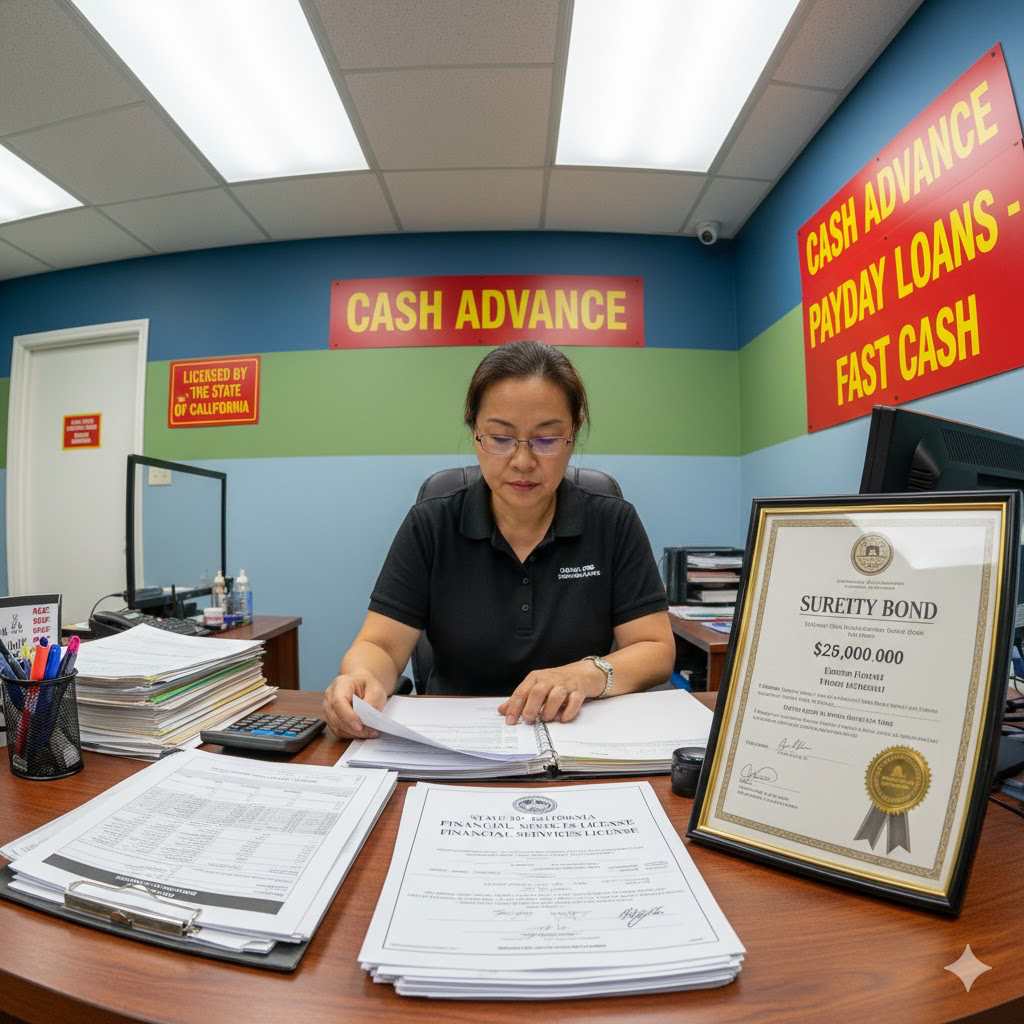
Your payday lending business generated $180,000 in revenue last month, but a single customer complaint about undisclosed fees could trigger a $25,000 bond claim that destroys your company, revokes your license, and makes rebonding impossible at any price. Seven states mandate payday loan bonds while eighteen others banned payday lending entirely, creating a patchwork regulatory landscape where operating legally in Illinois requires $50,000 per location but moving operations thirty miles into Wisconsin eliminates bonding requirements altogether. Religious organizations and consumer protection groups wage continuous campaigns to eliminate payday lending through legislation, regulatory pressure, and public stigma campaigns that convince surety companies to charge premium rates between 5% and 15% for an industry many underwriters consider too risky to bond regardless of credit quality.
The payday loan bond protects borrowers and state regulators from financial harm caused by payday lenders who engage in predatory practices, violate disclosure requirements, charge excessive fees, or fail to comply with state lending laws. This surety bond guarantees that short-term lenders will follow all applicable regulations governing loan amounts, interest rate caps, repayment terms, and consumer protections. When lenders violate these requirements, borrowers or state agencies can file claims against the bond to recover financial losses, and the lender must reimburse the surety company for all paid claims plus associated costs.
Understanding Payday Loan Bonds and Alternative Names
A payday loan bond—also marketed as a small loan license surety bond, deferred presentment provider surety bond, consumer lender bond, or short-term lender bond—is a specialized license and permit surety bond required by certain states before issuing business licenses to payday lending operations. The bond creates a three-party contractual relationship protecting consumers who borrow from payday lenders offering small-dollar, short-term loans typically ranging from $100 to $1,500 with repayment due on the borrower’s next payday. These loans characteristically charge high interest rates, require no credit checks, and target consumers who cannot access traditional credit products due to poor credit histories or urgent cash needs.
The terminology varies significantly across jurisdictions reflecting different regulatory frameworks and political sensitivities. States attempting to distance themselves from the “payday loan” stigma while still permitting the business model often require bonds under names like consumer lender bonds, small loan bonds, or deferred presentment provider bonds. This naming flexibility creates confusion for lenders operating across multiple states who must navigate different bond requirements, varying terminology, and inconsistent regulatory expectations despite providing fundamentally identical services.
The bond protects against numerous violations including charging interest rates exceeding state caps, failing to provide required disclosures about total borrowing costs, engaging in prohibited collection practices, making loans to borrowers who already have outstanding payday loans when state law prohibits multiple simultaneous loans, and operating without proper licensing. The bond’s continuous nature means coverage remains active from the effective date until either the lender or surety formally cancels coverage, creating extended liability exposure that persists years after business operations cease if violations occurred during the coverage period.
States Requiring Payday Loan Bonds
Payday loan bonding requirements exist in a complex regulatory environment where only select states permit payday lending and mandate surety bonds as a condition of licensure. The states requiring bonds include California, Colorado, Illinois, Maryland, Missouri, Nevada, and Washington, though this list remains fluid as legislatures continuously debate payday lending restrictions. Illinois imposes particularly stringent requirements with $50,000 bonds required for each physical branch location, creating substantial bonding costs for multi-location operations. Maryland similarly requires $12,000 for the initial location and an additional $12,000 for every expansion site.
Minnesota represents an extreme outlier with bond requirements ranging from $500,000 to $1,500,000 depending on loan volume and business structure, making it prohibitively expensive for small operators to enter the market. This astronomical bonding requirement effectively functions as a market entry barrier limiting payday lending to large, well-capitalized corporations capable of absorbing the substantial annual premiums these bonds generate. California maintains a more moderate $25,000 requirement for finance lenders and brokers, while Nevada requires $50,000 plus an additional $5,000 for each new location opened.
States that have banned payday lending entirely include Arizona, Arkansas, Connecticut, Georgia, Maryland (effectively through 36% interest rate cap), Massachusetts, Montana, New Hampshire, New Jersey, New York, North Carolina, Pennsylvania, South Dakota, Vermont, West Virginia, and the District of Columbia. These jurisdictions concluded that payday lending’s negative social impacts—including debt traps, predatory pricing, and targeting of vulnerable populations—outweigh any benefits the industry provides. Lenders attempting to operate in these states face criminal penalties, and obtaining surety bonds becomes impossible as no legitimate surety company will bond illegal activity.
The remaining states either permit payday lending without bonding requirements or regulate it through alternative mechanisms such as strict interest rate caps, loan amount limits, or cooling-off periods between loans. This fragmented regulatory landscape forces payday lenders operating across multiple states to maintain expertise in varying requirements, secure multiple bonds under different state regulations, and continuously monitor legislative changes that could eliminate their ability to operate in specific jurisdictions.
Who Needs Payday Loan Bonds
Businesses offering short-term, small-dollar loans to consumers where repayment coincides with the borrower’s next paycheck must secure payday loan bonds in states mandating coverage. This includes traditional storefront payday lenders operating physical locations where borrowers can walk in to obtain cash loans, online payday lenders providing loans through internet platforms even when no physical presence exists in a borrowing state, deferred presentment service providers who accept post-dated checks from borrowers and agree to hold them until the next payday, and title loan companies that secure short-term loans with vehicle titles while operating under payday lending regulations in some jurisdictions.
The requirement typically applies based on where the borrower resides rather than where the lender maintains its headquarters or primary operations. An online payday lender based in Delaware but making loans to California residents must obtain a California payday loan bond and comply with California regulations. This creates complex compliance burdens for digital lenders attempting to operate nationally, as they theoretically need bonds in every state where they accept loan applications. Some lenders attempt to circumvent state regulations by partnering with tribal entities claiming sovereign immunity from state lending laws, though courts increasingly reject these arrangements.
Multi-location operators face particularly onerous bonding requirements in states like Illinois and Maryland where each physical location requires a separate bond. A payday lending chain operating fifteen Illinois storefronts needs $750,000 in total bonding—fifteen separate $50,000 bonds covering each location. This per-location requirement prevents companies from obtaining single blanket bonds covering all operations, substantially increasing administrative complexity and annual premium costs. Each location bond must list the specific address covered, and opening a new location requires obtaining an additional bond before commencing lending operations.
Small loan companies, money lenders, consumer finance companies, and consumer credit organizations offering small-dollar loans with high interest rates and short repayment terms also fall under payday lending regulations in many states even if they don’t explicitly market themselves as payday lenders. State regulators focus on the economic substance of lending transactions rather than marketing terminology, meaning companies cannot avoid bonding requirements simply by calling their products something other than payday loans. Any lending operation charging effective annual interest rates above 36% on loans under $2,500 with repayment terms under six months likely triggers payday lending regulations in states with such laws.
How Payday Loan Bonds Work
The payday loan bond operates through a three-party agreement creating distinct roles and obligations. The principal is the payday lender obtaining the bond to satisfy state licensing requirements. The obligee is the state regulatory agency requiring the bond, typically a state banking department, financial services department, or consumer protection agency. The surety is the insurance company issuing the bond and guaranteeing the principal’s compliance with state regulations. This triangular relationship protects consumers and state regulators while creating substantial liability exposure for lenders who violate regulations.
When a borrower believes a payday lender violated state lending laws—such as charging excessive interest, failing to provide required disclosures, or engaging in harassing collection practices—they can file a complaint with the state regulatory agency. The agency investigates the complaint and determines whether violations occurred. If the investigation substantiates violations, the borrower can file a claim against the payday loan bond seeking financial compensation for losses suffered. The claim must typically be filed within the bond’s active coverage period, though some states permit claims for violations that occurred during coverage even if discovered years later.
Upon receiving a valid claim, the surety company investigates independently to verify the facts and assess liability. If the surety determines the claim has merit, they pay the claimant up to the full bond amount to satisfy the loss. However, this payment does not absolve the payday lender of responsibility. Under the indemnity agreement signed when obtaining the bond, the lender must reimburse the surety for every dollar paid plus investigation costs, legal fees if litigation became necessary, and interest accruing from the payment date. This indemnification obligation survives business closure, bankruptcy in many cases, and continues indefinitely until satisfied.
The bond’s continuous nature creates indefinite liability exposure. Unlike insurance policies that renew annually and only cover events during the policy term, payday loan bonds remain in force from the effective date until formally canceled by either party. Even after canceling the bond and ceasing operations, the lender remains liable for claims arising from violations that occurred while the bond was active. This tail liability can extend five to ten years depending on state statutes of limitations, meaning a lender who operated from 2015 to 2018 could face claims until 2028 for violations during the operational period.
Bond Amounts and State-Specific Requirements
Payday loan bond amounts vary dramatically across states reflecting different regulatory philosophies and assessments of consumer risk. The following table illustrates the wide disparities:
| State | Bond Amount | Additional Requirements |
|---|---|---|
| California | $25,000 | $300 application fee, $100 investigation fee, $200 processing fee |
| Colorado | Varies | Based on previous year’s annual loan volume |
| Illinois | $50,000 | Per location, $500,000 maximum, expires December 31 annually |
| Kansas | Varies | 1% of bond amount typical premium |
| Maine | $50,000 | Annual premium approximately $375 |
| Maryland | $12,000 | Per location ($12,000 initial + $12,000 each additional) |
| Minnesota | $500,000-$1,500,000 | Based on loan volume and business type |
| Missouri | $100,000 | Fixed amount |
| Nevada | $50,000 | Plus $5,000 per additional location |
| Washington | $10,000 | Costs vary, verify with state |
This table reveals philosophical differences in how states assess payday lending risk. Minnesota’s extraordinarily high requirements effectively limit market entry to large corporations, while Washington’s modest $10,000 requirement creates minimal barriers for small operators. Illinois’s per-location structure with December 31 expiration creates administrative complexity requiring annual rebonding across all locations simultaneously. States can prorate bonds issued mid-year, allowing lenders opening in June to pay half the annual premium for coverage through December 31.
Colorado’s volume-based approach attempts to scale bond requirements to actual lending activity rather than imposing arbitrary flat amounts. Lenders with $500,000 in annual loan volume might need $50,000 bonds while lenders with $10 million in volume could need $250,000 or more. This creates fairness by requiring larger, riskier operations to post proportionally higher bonds while not penalizing small startups with excessive bonding costs they cannot afford. However, it also creates uncertainty as lenders don’t know their exact bonding requirements until the state reviews their previous year’s lending volume.
States without per-location requirements typically permit a single blanket bond covering all locations within the state, substantially reducing costs for multi-site operators. A lender with ten California locations needs only one $25,000 bond covering all sites, while the same operator in Illinois needs ten separate $50,000 bonds totaling $500,000. This discrepancy significantly impacts expansion decisions as adding locations in Illinois increases bonding costs by $50,000 per site while adding California locations creates no additional bonding expense.
Costs and Pricing Factors
Annual premiums for payday loan bonds represent a percentage of the required bond amount, typically ranging from 0.7% to 15% depending primarily on the principal’s personal credit score, business financial strength, and compliance history. The industry’s negative reputation substantially inflates rates compared to lower-risk bond types, as many surety companies either decline payday lending business entirely or charge elevated premiums reflecting their perception of high claim likelihood.
Lenders with excellent personal credit above 720 and strong business financials might qualify for rates between 0.7% and 2%, meaning a $50,000 bond costs $350 to $1,000 annually. Good credit from 680 to 719 typically sees rates of 2% to 5%, or $1,000 to $2,500 on the same bond. Fair credit from 620 to 679 faces 5% to 10% rates costing $2,500 to $5,000 annually. Below 620, rates climb to 10% to 15%, potentially reaching $7,500 annually for a single $50,000 bond. Some sureties automatically decline applicants below 600 regardless of other qualifications.
Business financial strength becomes critical for multi-location operators requiring aggregate bonding exceeding $100,000. Sureties evaluate business tax returns for multiple years, audited or reviewed financial statements, profit and loss statements, balance sheets, accounts receivable aging reports, and cash flow projections. They analyze net worth, debt-to-equity ratios, profitability trends, working capital adequacy, and operational stability. Financially strong companies with substantial positive net worth, consistent profitability, and healthy cash flow may qualify for rates below 2% even on large aggregate bonds. Companies with negative net worth, sustained losses, or poor cash flow face rates approaching 15% or outright declinations.
Compliance history dramatically impacts pricing beyond credit and financials. Lenders with clean regulatory records showing no consumer complaints, no state enforcement actions, no license suspensions, and no previous bond claims receive favorable consideration. Any history of regulatory violations, consumer complaints upheld by state agencies, fines or penalties imposed by regulators, or previous bond claims increases rates substantially and may make bonding impossible. Some lenders discover they cannot obtain bonding because prior violations or outstanding fines create unacceptable risk that no surety will underwrite.
The number of business locations exponentially increases costs in states requiring per-location bonds. An Illinois operator with twenty locations needs $1 million in aggregate bonding. Even at favorable 2% rates, annual premiums reach $20,000. At elevated 10% rates for fair credit, premiums balloon to $100,000 annually—a massive fixed cost before generating any revenue. This per-location structure effectively limits payday lending to well-capitalized operators who can absorb substantial bonding expenses.
Application Process and Underwriting
Obtaining a payday loan bond requires completing applications providing comprehensive information about the business and all owners. Applications request business legal name, all assumed names and DBAs, business entity type and formation date, federal employer identification number, state tax IDs for all operating jurisdictions, physical addresses of all locations, complete ownership information for anyone holding 5% or more interest, and exhaustive disclosure of any bankruptcies, judgments, liens, regulatory actions, or previous bond claims involving the business or any owner.
Single-location applicants with good credit often receive instant or same-day approval through streamlined online applications. These automated systems pull credit reports, verify basic information, and issue approvals within minutes for straightforward situations. Applicants with credit scores above 680 and no adverse history can often obtain bonds immediately with quoted premiums, execute required paperwork electronically, pay premiums online, and receive bond certificates via email within hours.
Complex applications involving multiple locations, elevated bond amounts exceeding $100,000, poor credit, or adverse regulatory history trigger detailed manual underwriting requiring three to ten business days. Underwriters request business federal and state tax returns for three years, audited or reviewed financial statements for the most recent fiscal year, interim financial statements if the fiscal year ended more than ninety days ago, personal financial statements from all owners showing assets and liabilities, bank statements for recent months, and detailed explanations of any regulatory violations, consumer complaints, or previous bond claims with documentation showing resolution.
Underwriters analyze financial ratios, assess liquidity, evaluate profitability sustainability, and determine whether the business possesses sufficient financial strength to continue operations while simultaneously satisfying potential bond claims. They contact state regulatory agencies to verify licensing status, check for pending enforcement actions, and confirm no outstanding fines or penalties exist. Some sureties require personal indemnification from additional guarantors with strong credit to supplement weak applicant financials, effectively forcing owners’ family members or business partners to personally guarantee repayment of any bond claims.
Upon approval, applicants receive premium quotes specifying annual costs, available payment options including potential multi-year discounts, proposed effective dates, and any special conditions such as collateral requirements. After accepting quotes and paying premiums, sureties issue bond certificates listing the principal, obligee, bond amount, effective date, and any endorsements or modifications. Lenders submit these certificates to state licensing agencies along with license applications, required fees, and other documentation. The state reviews everything before issuing licenses permitting lending operations to commence.
Industry Reputation and Market Challenges
Payday loan bonds exist in a uniquely hostile industry environment where persistent negative publicity, aggressive opposition from consumer advocacy groups and religious organizations, and frequent legislative efforts to ban the entire business model create substantial bonding challenges. Many surety companies approach payday lending cautiously or decline to write coverage entirely, limiting market capacity and inflating premiums for available coverage. Religious groups organize petition drives, lobby legislatures, and conduct public awareness campaigns portraying payday lenders as predatory operations that trap vulnerable borrowers in endless debt cycles.
Consumer protection organizations document cases of borrowers who took initial $300 loans and repaid $2,000 through repeated rollovers and renewals, fueling demands for stricter regulations or outright bans. Media coverage emphasizes worst-case scenarios while rarely discussing borrowers who successfully use payday loans for legitimate emergency expenses and repay without difficulty. This one-sided narrative creates political pressure that results in increasingly restrictive regulations making the business less profitable while simultaneously increasing compliance costs and bonding requirements.
Surety companies must balance potential premium income against elevated claim risks in an industry with documented compliance problems and persistent negative attention from regulators and advocacy groups. Many sureties conclude the reputational risk and claim exposure outweigh potential profits, leading them to exit the payday lending bonding market entirely. This market contraction concentrates available bonding capacity with specialized sureties who charge premium rates reflecting limited competition and elevated perceived risk. Lenders often discover that only two or three surety companies will consider their applications, and those companies charge rates substantially higher than for other license and permit bonds.
The industry’s rapid expansion and equally rapid contraction in certain states creates boom-and-bust cycles that complicate bonding relationships. When states tighten regulations or impose rate caps that eliminate profitability, lenders suddenly abandon markets and cancel bonds. Sureties facing waves of cancellations with no new business to replace lost premiums become even more reluctant to write payday lending coverage. Those that continue often impose strict underwriting requirements, demand substantial collateral, or charge rates at the high end of normal ranges.
Frequently Asked Questions
Do I need separate bonds for each state where I make online loans? Yes, if you offer payday loans to residents of multiple states requiring bonds, you must obtain separate bonds in each state. State regulators assert jurisdiction over any lender making loans to their residents regardless of where the lender’s physical operations are located. An online lender based in Nevada making loans to California, Illinois, and Washington residents needs separate bonds in all three borrowing states plus Nevada if operating from there. Each state’s bond must be issued by a Treasury-approved surety authorized to write bonds in that jurisdiction, and each state’s regulatory agency becomes a separate obligee on the respective bonds.
What happens if I close my business but had the bond in force for five years? Your liability under the bond continues for violations that occurred during the five-year operational period even after canceling coverage and closing the business. State statutes of limitations typically allow claims for three to ten years after violations occur, meaning you remain exposed to potential claims until these limitation periods expire. If a borrower files a complaint in year seven about violations from year two, and the state substantiates the claim, the surety pays the claim and pursues collection against you personally under the indemnity agreement. You cannot escape this liability through business closure, and in many cases even personal bankruptcy won’t discharge the debt owed to the surety.
Can I operate in multiple states using a single bond? No, each state requires its own bond issued separately listing that state’s regulatory agency as obligee. No state accepts bonds issued for different jurisdictions or blanket bonds covering multi-state operations. Each state maintains its own bonding requirements, bond forms, regulatory agencies, and licensing procedures. Even if you operate ten locations all in neighboring towns but split across two states, you need separate bonds in each state. The exception is a single state permitting one bond to cover multiple locations within that state’s boundaries.
What if my bond amount is insufficient to cover multiple claims filed against me? The bond amount represents the maximum the surety pays across all claims during the bond’s life, not per claim. If your $50,000 bond faces three valid claims of $30,000, $25,000, and $40,000, the surety pays $50,000 total—not $95,000. The state typically allocates the bond amount among valid claims either on a first-come-first-served basis or pro-rata if claims arrive simultaneously. You remain personally liable for all amounts claimed beyond the bond limit, and the state typically revokes your license immediately upon exhausting the bond. Operating without an adequate bond after it’s exhausted violates licensing requirements and may result in criminal charges.
Do bad credit lenders have any options for obtaining required bonds? Several specialized surety companies offer high-risk bonding programs for payday lenders with poor credit, previous bankruptcies, tax liens, judgments, or other financial problems that disqualify them from standard market rates. These programs charge substantially higher premiums typically ranging from 10% to 15% of the bond amount, compared to 1% to 3% for good credit applicants. Many require collateral equal to 10% to 100% of the bond amount through cash deposits, certificates of deposit, or letters of credit from banks. Some demand personal indemnification from additional guarantors with strong credit to supplement the primary applicant’s weak profile. Despite higher costs, these programs enable lenders with credit problems to meet state bonding requirements and obtain licenses.
Can religious organizations’ lobbying efforts actually prevent me from getting bonded? While religious groups cannot directly prevent sureties from issuing bonds, their sustained advocacy campaigns influence the regulatory environment and industry reputation in ways that indirectly affect bonding availability. When religious organizations successfully lobby for stricter regulations, interest rate caps, or outright bans, sureties perceive increased risk and respond by exiting the market or raising rates. Their public awareness campaigns portraying payday lending negatively create reputational concerns for surety companies that prefer avoiding controversial industries. Some major sureties cite reputational risk as their reason for declining all payday lending bonds regardless of financial qualifications. The cumulative effect of sustained opposition contracts bonding market capacity and drives up costs for available coverage.
What happens if I violate regulations in one state while operating in several states? Each state’s bond covers only violations occurring in that specific state. If you violate Illinois regulations, only your Illinois bond is exposed to claims—your California, Nevada, and Washington bonds remain unaffected. However, violations in one state create collateral consequences affecting your bonding and licensing in all states. Surety companies discover violations when conducting annual renewal underwriting or when state agencies report claims. Upon learning of violations in any state, sureties often cancel or decline renewal on all bonds you hold with them regardless of jurisdiction. State regulators share information about problem lenders through multi-state databases, and violations in one state often trigger license revocations or investigations in other states where you operate.
How do tribal sovereignty claims affect state bonding requirements? Some payday lenders attempt to circumvent state bonding requirements and regulations by partnering with Native American tribal entities claiming sovereign immunity from state law. These arrangements typically involve the tribe nominally owning the lending operation while the non-tribal lender provides capital, operations, and management in exchange for most profits. Lenders using this structure argue they aren’t subject to state licensing or bonding requirements because tribal sovereignty preempts state regulation. However, federal courts increasingly reject these arrangements as shams designed to evade consumer protection laws, finding that non-tribal lenders remain subject to state regulation when they effectively control lending operations despite nominal tribal ownership. States successfully enforce bonding requirements against these lenders.
Can I get a blanket bond covering all my locations or do I need separate bonds for each? This depends entirely on the specific state’s requirements. Illinois explicitly requires separate $50,000 bonds for each physical branch location, making blanket bonds impossible and creating massive bonding costs for multi-site operators. Maryland similarly requires separate $12,000 bonds per location. However, California permits a single $25,000 bond covering all locations within the state, dramatically reducing costs for operators with multiple California sites. Nevada uses a hybrid approach requiring $50,000 for the first location plus $5,000 for each additional location, which can be structured as either a single bond with the combined amount or separate bonds for each site. Always verify requirements with the specific state’s regulatory agency.
What recourse do I have if a borrower files a fraudulent claim against my bond? You have the right to contest any claim filed against your bond through the surety company’s investigation process and through state administrative proceedings if the state regulatory agency becomes involved. When a claim is filed, immediately provide the surety with comprehensive documentation demonstrating the claim’s invalidity—including loan agreements, disclosure documents, payment records, communications with the borrower, and any other evidence refuting the allegations. Participate actively in the surety’s investigation and provide sworn statements if necessary. If the state regulatory agency investigates, you typically have rights to respond in writing, present evidence, and request administrative hearings before any determination. However, you cannot sue the borrower for defamation or filing a false claim until after the investigation concludes and the claim is definitively rejected.
Conclusion
Payday loan bonds represent entry barriers and ongoing compliance costs in an industry facing sustained opposition from consumer advocates, religious organizations, and regulatory agencies seeking to curtail or eliminate short-term high-interest lending. The patchwork state-by-state regulatory structure creates complex compliance challenges where operating legally in some states requires $50,000 per location while neighboring jurisdictions ban the business entirely. Bonding costs ranging from less than 1% to over 15% annually depending on credit quality substantially impact profitability, with multi-location operators in states requiring per-location bonds facing six-figure annual premium expenses before generating any revenue.
The industry’s negative reputation contracts bonding market capacity as major surety companies decline to write payday lending coverage regardless of financial qualifications, concentrating available bonding with specialized sureties who charge elevated rates. Lenders with poor credit, adverse regulatory histories, or complex multi-state operations often discover that obtaining required bonds at any price proves impossible, effectively excluding them from markets they wish to enter. The continuous nature of bonds creates indefinite tail liability extending years after operations cease, exposing former operators to claims for violations that occurred during active coverage periods.
Successfully navigating payday lending bonding requires maintaining excellent personal and business credit, ensuring spotless regulatory compliance across all operating jurisdictions, working with specialized surety brokers who maintain relationships with willing underwriters, and factoring substantial bonding costs into business planning when evaluating market entry or expansion decisions. Lenders considering entering this industry must assess not only customer demand and profit potential but also regulatory sustainability, bonding availability, and reputational risks that could render operations unsustainable regardless of business model success.
Five Things the Top Sites Didn’t Tell You
The National Multistate Licensing System eliminated state-to-state bond filing complexity but created new centralized risks for widespread revocations across all licensed states simultaneously. When states began using NMLS for electronic surety bond filing, lenders gained efficiency by uploading bond certificates once rather than submitting paper certificates to multiple state agencies. However, this centralization means that violations reported in any single state immediately become visible to all states where the lender holds licenses through NMLS. A consumer complaint substantiated in Nevada triggers automatic flags visible to California, Illinois, Washington, and every other state where the lender operates through NMLS. Regulators coordinate enforcement actions through NMLS, enabling simultaneous multi-state license suspensions that shut down nationwide operations instantly when previously states acted independently on slower timelines.
Some payday lenders maintain active surety bonds in states where they no longer operate to prevent “gaps in coverage” that would disqualify them from bonding in new states they wish to enter. Surety underwriters view coverage gaps—periods where a lender operated but lacked active bonds—as major red flags suggesting possible unlicensed operations or attempts to evade bonding requirements. A lender who operated in Missouri from 2015-2017 then exited that market might maintain a Missouri bond through 2025 at minimal cost to avoid creating a gap that would complicate obtaining bonds for Texas expansion in 2024. This practice costs hundreds to thousands annually in unnecessary premiums but prevents underwriting complications that could delay or prevent approval when entering attractive new markets. Some specialized surety brokers explicitly advise clients to maintain bonds in dormant states until certain that no future multi-state expansion will occur.
The Dodd-Frank Act’s creation of the Consumer Financial Protection Bureau fundamentally altered the payday lending regulatory landscape by establishing federal oversight that previously didn’t exist, but CFPB’s payday lending rule remains perpetually in regulatory limbo creating uncertainty that affects bond pricing. Before 2010, payday lending faced only state-level regulation with no federal agency oversight. The CFPB’s 2017 payday lending rule attempted to impose federal underwriting requirements including ability-to-repay assessments and limits on loan sequences, but industry legal challenges, congressional actions under the Congressional Review Act, and subsequent CFPB re-examination of the rule created ongoing regulatory uncertainty. Surety companies factor this federal regulatory uncertainty into pricing because unclear future compliance requirements create unknown claim risks. Lenders seeking bonds often face questions about CFPB compliance strategies even though the final rule’s applicability remains contested.
Military Lending Act violations create bond claim exposure but also federal criminal liability that extends beyond surety bond coverage, making these claims particularly catastrophic for lenders. The federal Military Lending Act caps interest rates at 36% annually for active duty servicemembers and their dependents, effectively prohibiting payday lending to military borrowers. When lenders violate the MLA by making loans to military borrowers at typical payday lending rates, they face not only bond claims for overcharged interest but also federal criminal prosecution, treble damages in civil litigation, and Department of Defense referrals to the Justice Department. The surety bond covers civil penalties and borrower damages but provides no protection against criminal fines or imprisonment. Some lenders discovered MLA violations years after making loans when borrowers deployed overseas and military legal assistance attorneys reviewed their finances, triggering investigations that exhausted bond coverage, bankrupted the companies, and resulted in criminal convictions for owners.
Several states permit payday lenders to substitute letters of credit or cash deposits for surety bonds, but these alternatives rarely prove economically viable despite eliminating credit score concerns. California, Nevada, and a few other states accept letters of credit from qualified banks or cash deposits held in special accounts as bond alternatives. A $50,000 letter of credit requires a bank to issue an irrevocable guarantee to the state, which typically requires the lender to maintain $50,000 in restricted deposits or pledge $50,000 in acceptable collateral to the bank. Banks charge fees of 1% to 5% annually for letters of credit while simultaneously restricting access to the pledged funds or collateral. Cash deposits require the full $50,000 held in escrow earning minimal interest. For lenders with good credit paying 1% surety bond premiums ($500 on $50,000), these alternatives make no economic sense. They only benefit lenders unable to obtain surety bonds at any price, allowing them to enter markets by locking up capital that could otherwise fund lending operations.