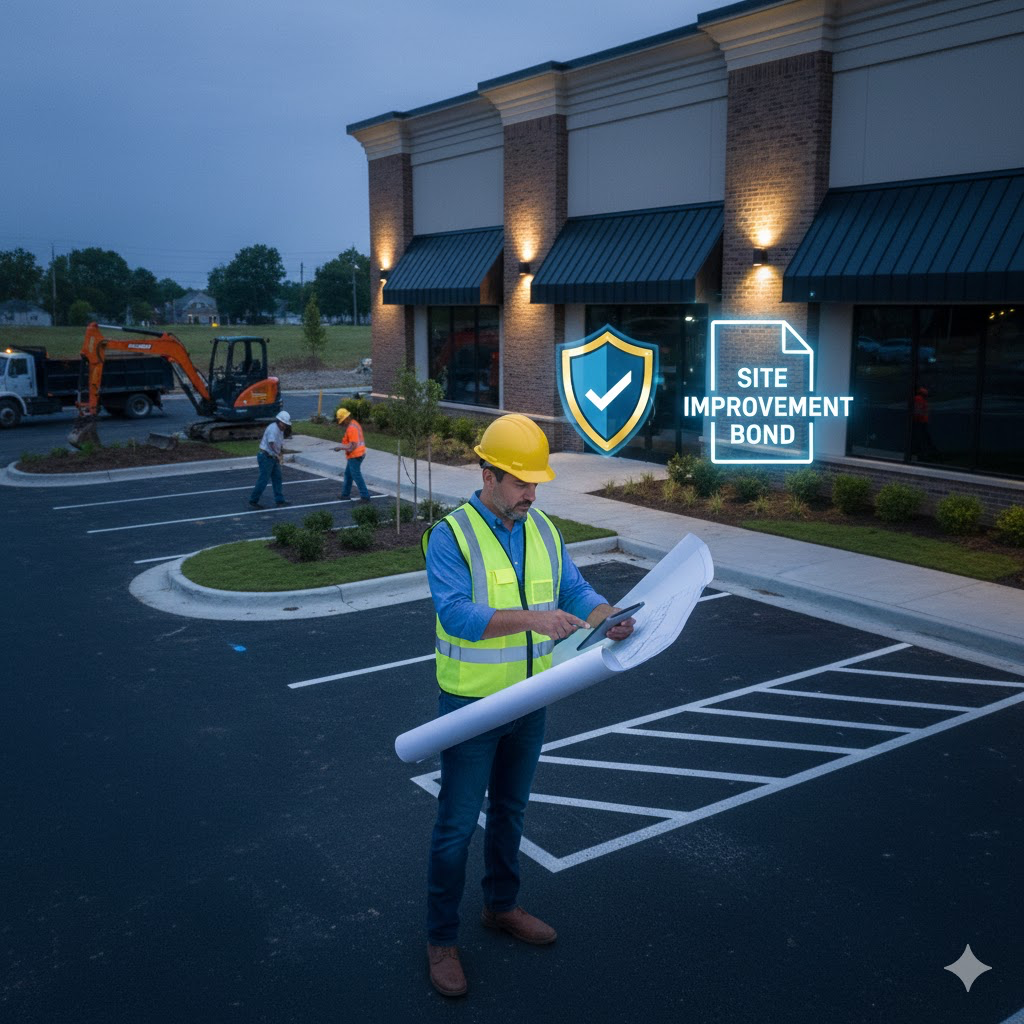
Imagine owning a thriving retail center when the city suddenly mandates upgraded drainage systems and expanded parking to meet new codes. You hire a contractor who collects a $200,000 deposit, begins tearing up your parking lot, then vanishes after discovering the project costs more than estimated. Your property now sits half-demolished, losing $30,000 monthly in tenant revenue, while the city threatens daily fines for code violations. This nightmare scenario—and thousands like it each year—is exactly why municipalities require site improvement bonds before approving renovation work on existing properties.
Understanding Site Improvement Bonds
A site improvement bond is a specialized surety bond guaranteeing that contractors or developers will complete all required improvements to existing structures, properties, or sites according to approved plans and building codes. These bonds protect property owners, municipalities, and public interests when renovation, expansion, or upgrade work occurs on properties that already exist, as opposed to new construction projects.
The fundamental purpose is straightforward: ensure that improvement projects get finished properly even if the contractor encounters financial problems, underestimates costs, or simply abandons the work. Without these bonds, property owners and municipalities would shoulder enormous financial risk every time someone proposed improvements to existing sites. The bond provides a financial backstop, guaranteeing access to funds needed to complete work if the original contractor defaults.
The Critical Distinction: Site Improvement Bonds Versus Subdivision Bonds
Understanding the difference between site improvement bonds and subdivision bonds prevents costly confusion during project planning. Site improvement bonds apply exclusively to improvements, renovations, or upgrades on existing structures, properties, or developed sites. Examples include retrofitting an existing shopping center with new lighting systems, expanding parking facilities at an operational office building, or upgrading drainage infrastructure in an established industrial park.
Subdivision bonds, in contrast, guarantee completion of brand new infrastructure for newly created developments. When a developer divides raw land into residential lots or creates an entirely new commercial park requiring streets, utilities, and drainage systems where none existed, subdivision bonds provide the required security. The development creates something entirely new rather than improving what already exists.
This distinction matters enormously because underwriting standards, risk profiles, pricing structures, and legal obligations differ significantly between the two bond types. Contractors and developers who confuse these bond categories may submit incorrect applications, face approval delays, or discover they’ve obtained the wrong security instrument for their project requirements.
How Site Improvement Bonds Work
Site improvement bonds create a three-party contractual relationship binding the principal, obligee, and surety together in mutual obligations. The principal—typically the contractor, developer, or property owner initiating the improvements—purchases the bond and accepts ultimate financial responsibility for completing the work. The obligee, usually the local government agency or property owner requiring the bond, receives protection against the principal’s default. The surety company issues the bond and guarantees the obligee will receive either completed improvements or financial compensation if the principal fails to perform.
When the principal applies for and receives a site improvement bond, they’re essentially securing a specialized form of credit that pays claims when specific conditions occur. Unlike traditional insurance where premiums pool risk across many policyholders, surety bonds assume the principal will fulfill their obligations. The surety carefully underwrites each application because they expect zero losses—the bond exists as financial assurance, not as payment for anticipated claims.
If the principal defaults on their improvement obligations by abandoning the project, performing substandard work, missing deadlines, or violating building codes, the obligee may file a claim against the bond. The surety investigates every claim thoroughly, examining project documentation, inspecting work performed, reviewing contracts and specifications, and interviewing all relevant parties. When investigations confirm valid claims, the surety either compensates the obligee up to the bond’s full amount or arranges for qualified contractors to complete the remaining work.
However, the principal’s financial responsibility doesn’t end with surety payment. Through the indemnity agreement signed when obtaining the bond, principals guarantee they will reimburse the surety for every dollar spent settling claims, plus investigation costs, legal fees, and contractor expenses. This structure explains why sureties conduct such rigorous underwriting—they’re extending credit based on the principal’s ability to ultimately repay any claims.
Types of Improvements Typically Covered
Site improvement bonds guarantee completion of diverse improvement categories depending on project scope and jurisdictional requirements. Infrastructure improvements represent the most common category, including upgrades to parking lots and driveways, lighting systems and electrical improvements, roads and pavement within existing developments, curbs and gutters, and sidewalks and pedestrian facilities.
Utility and drainage improvements form another major category, covering storm drainage systems and upgrades, sewer line improvements and connections, water main enhancements, erosion and sediment controls, and culvert installations or repairs. These improvements often trigger bond requirements because they affect public infrastructure or environmental compliance.
Site preparation and landscaping improvements include grading and earthwork for site modifications, landscaping installations or upgrades, monument and signage installations, and aesthetic enhancements required by local ordinances. Many municipalities expanded bonding requirements beyond purely functional improvements to include aesthetic elements that enhance community appearance.
Structural and building improvements occasionally fall under site improvement bond coverage when they’re required as conditions for operating permits, certificates of occupancy, or zoning compliance. These might include facade improvements mandating by historic districts, accessibility modifications required for ADA compliance, or structural reinforcements needed to meet updated building codes.
Cost and Pricing Structure
Site improvement bond premiums typically range from one to three percent of the total bond amount annually for well-qualified applicants. Developers and contractors with excellent credit scores above 720, substantial industry experience, strong business financials, and proven track records on similar projects often secure rates at the lower end of this spectrum. Some surety providers quote rates as low as 1.5 to 2 percent for exceptionally qualified high-net-worth clients undertaking large projects with secured financing.
For applicants with credit challenges, limited experience, or weaker financial positions, premiums may extend from three to five percent of the bond amount. A handful of specialty sureties accept higher-risk applicants at premium rates reaching seven to ten percent, though these situations require compelling compensating factors like secured escrow accounts, substantial collateral, or equity investments in the improved property.
Several factors influence where your premium falls within these ranges. The bond amount drives base pricing, with larger obligations generally receiving better per-dollar rates due to economies of scale. Your personal and business credit history significantly impacts pricing because sureties view credit scores as predictive of overall financial responsibility and default likelihood. Years in business and documented completion history on similar projects demonstrate capability, potentially reducing rates by showcasing your track record.
Project complexity and scope affect pricing because complicated improvements involving multiple trades, extended timelines, or technical challenges present greater performance risk. Geographic location influences rates since local market conditions, contractor availability, labor costs, and regulatory environments vary dramatically across regions. The security of your funding source matters considerably—projects backed by confirmed bank financing from reputable lenders present far less risk than those relying on speculative funding or developer equity alone.
Current bonding capacity also factors into underwriting decisions. Contractors or developers who already carry substantial outstanding bond obligations may find additional capacity limited or more expensive because sureties worry about overextension. Financial institutions involved in the project, particularly construction lenders requiring bonds as loan conditions, can complicate the picture by creating dual-obligee scenarios that increase surety exposure.
Application Process and Requirements
Obtaining a site improvement bond requires thorough preparation and comprehensive documentation demonstrating your financial capacity and professional capability. The process begins with completing a detailed bond application and improvement questionnaire specifically designed for site improvement projects. These forms request information about your company, principals, the specific project, timeline, budget, and any existing bond obligations.
The subdivision or improvement agreement drafted by the obligee outlines all work requirements, completion deadlines, quality standards, and security amounts. Sureties review these agreements carefully to understand their potential exposure and verify that bond forms align with actual project obligations. Many jurisdictions provide standardized bond forms while others allow customized instruments—the surety evaluates each scenario individually.
Financial documentation forms the backbone of underwriting decisions. You’ll need business financial statements covering the past three years, preferably audited or reviewed by CPAs for bonds exceeding $500,000. These statements should include balance sheets, income statements, statements of cash flows, and detailed notes explaining any unusual entries or transactions. Personal financial statements from all company principals help sureties evaluate overall financial strength and personal commitment to the business. Recent balance sheets provide snapshots of current financial positions.
Banking information including letters of credit, loan documents, existing credit facilities, and banking relationships demonstrates access to capital beyond retained earnings. Project-specific documentation includes engineer’s estimates with professional seals confirming cost calculations and technical feasibility. Market analysis or appraisals show project viability in current market conditions, helping sureties understand revenue potential and completion likelihood.
Details about funding sources clarify how you’ll finance the improvements—through bank loans, private equity, developer capital, or construction financing. If lenders are involved, commitment letters or loan documents provide assurance that funding will materialize. Business entity documents such as articles of incorporation, partnership agreements, or LLC operating agreements establish your legal structure and authority to enter contracts.
Prior project references with contact information allow sureties to verify past performance by interviewing previous clients, project owners, and lenders. Work-in-progress schedules showing current project commitments help underwriters assess whether you have capacity to handle additional work. For projects requiring set-aside bank financing, the surety will request a Set Aside Agreement from the bank detailing the commitment to fund the entire project with funds held exclusively for completing site improvements.
Critical Underwriting Considerations
Sureties evaluate site improvement bond applications using rigorous standards because these bonds carry unique risks compared to standard construction bonds. Underwriters focus intensely on four key areas when assessing applications.
Financial strength and seasoning receive primary attention. The surety examines working capital adequacy, debt-to-equity ratios, liquidity measures, profitability trends, and overall financial health. They’re particularly interested in whether you have sufficient resources to complete the project from your own funds if necessary, since site improvement bonds often lack the contract balance typical in traditional construction scenarios.
Scope of work evaluation involves detailed review of improvement specifications, technical complexity, trade coordination requirements, and timeline feasibility. Sureties consult with technical experts when projects involve specialized work or unusual requirements. They compare your proposed approach against industry standards and best practices.
Cost estimation accuracy matters enormously because underwriters need confidence that project budgets realistically reflect actual costs. They scrutinize engineer’s estimates, compare them against recent comparable projects, and verify that contingencies account for potential complications. Unrealistic budgets signal either inexperience or intentional lowballing—both red flags.
Source of funds verification ensures that money will be available when needed. Sureties distinguish between secured financing from reputable lenders, committed equity investments, speculative funding, and unsecured developer resources. Projects with confirmed bank financing backed by strong lender relationships receive favorable underwriting treatment.
Special Risk Factors
Site improvement bonds present several risk factors that distinguish them from typical construction bonds. The most significant involves the payment structure. In standard construction contracts, the project owner pays the contractor as work progresses, creating a contract balance that theoretically covers completion costs if the contractor defaults. With site improvement bonds, the principal often pays for everything from their own resources without receiving payments from the obligee. This means there’s no contract balance to offset completion costs if problems arise.
Dual-obligee exposure complicates many site improvement bonds. When construction lenders finance improvement projects, they frequently require naming them as co-obligees alongside the municipality or property owner. This creates scenarios where the surety faces potentially conflicting claims from obligees with disparate interests—the lender wants repayment while the municipality wants completed improvements. These contradicting interests dramatically increase surety exposure and typically result in higher premiums or more stringent underwriting.
Repayment guarantees in some bond forms create additional surety obligations. Certain bonds essentially guarantee financial institutions will receive repayment if the developer defaults, transforming what should be a performance guarantee into a financial guarantee. Sureties avoid these situations or require substantial collateral because the risk profile changes fundamentally.
The lack of natural completion incentives distinguishes site improvement bonds from contracts where owners make progress payments. When owners pay contractors incrementally, both parties benefit from timely completion. With site improvements financed entirely by the principal, external pressure to finish may be limited if the principal encounters financial difficulties or discovers the project costs more than anticipated.
Critical Warnings for Contractors and Developers
Several scenarios warrant special caution when dealing with site improvement bonds. General contractors who agree to post site improvement bonds on behalf of property owners face particularly dangerous exposure. Normally, contractors have the right to stop work if owners fail to pay for completed work. However, when the contractor posts the improvement bond in favor of a public agency, the contractor becomes obligated to complete all improvements and pay all subcontractors and suppliers regardless of whether the property owner pays them. This arrangement inverts normal risk allocation and can devastate contractors if owners default on payment obligations.
Bonds guaranteeing any form of “repayment” rather than simply completion of physical improvements create financial guarantee exposure that most sureties will only accept with substantial collateral or set-aside escrow accounts. Unless you have significant equity in the property being improved and the bond form guarantees only construction completion without repayment language, expect surety requests for additional security.
Long-term obligations deserve careful consideration because site improvement bonds, like performance bonds generally, cannot be canceled by either party. If your project takes longer than anticipated due to permitting delays, weather, unforeseen conditions, or other complications, you remain bonded and continue paying premiums until the municipality accepts completed improvements and releases the obligation. Multi-year projects can accumulate substantial premium costs.
Jurisdiction-specific requirements vary dramatically, so verify exact bonding requirements with local officials before assuming standard approaches will suffice. Some municipalities require both performance and payment bonds, others require maintenance bonds at reduced amounts after substantial completion, and still others have unique forms with onerous language that requires negotiation or amendment.
Benefits Despite Requirements
While site improvement bonds represent mandatory requirements in most jurisdictions rather than optional tools, they provide tangible benefits that enhance project feasibility and financial positioning. Most importantly, bonds preserve working capital by allowing you to post a bond costing one to three percent of the improvement value rather than depositing the full amount in cash with the municipality. For a $500,000 improvement project, paying $10,000 to $15,000 in bond premium instead of depositing $500,000 preserves $485,000 for construction activities, additional projects, or financial reserves.
Bonding capacity signals financial credibility to lenders, partners, and public agencies. Successfully obtaining substantial bonds demonstrates that professional underwriters have vetted your financial strength and capability. This credibility often translates into better financing terms, larger project opportunities, and improved negotiating positions with suppliers and subcontractors.
The underwriting process itself provides valuable risk assessment through the surety’s due diligence review. Experienced underwriters often identify potential project risks, financing gaps, budget inadequacies, or timeline challenges during their evaluation. Addressing these issues proactively before committing to projects prevents problems that might otherwise derail work midstream.
Bonds facilitate project approvals by satisfying municipal security requirements without protracted negotiations over alternative instruments. While letters of credit or cash deposits might substitute for bonds in some jurisdictions, these alternatives typically prove more expensive and tie up more capital.
Frequently Asked Questions
What happens if my contractor abandons my site improvement project?
If your contractor defaults by abandoning the project, failing to complete work properly, or violating building codes, you as the property owner or municipality can file a claim against the site improvement bond. Contact the surety company immediately and provide detailed documentation including proof of default, descriptions of incomplete or deficient work, cost estimates for completion, copies of contracts and approved plans, and correspondence showing attempts to resolve issues with the contractor. The surety will investigate your claim by reviewing documentation, inspecting the site, and contacting the contractor. If they determine the claim is valid, they’ll either pay you up to the bond amount to hire replacement contractors, or arrange directly for qualified contractors to complete the work. Throughout this process, keep detailed records and continue communicating with the surety to expedite resolution.
Can I get a site improvement bond with less-than-perfect credit?
Obtaining site improvement bonds with credit challenges is possible but more difficult than securing bonds with excellent credit. Some applicants with credit scores in the 600 to 700 range still qualify if they demonstrate strong compensating factors including substantial business financial strength independent of personal credit, significant industry experience with verifiable completion records, secured project financing from reputable lenders, personal net worth exceeding the bond amount, or willingness to provide collateral or co-signers with strong credit. Specialty sureties focus on higher-risk accounts and may provide bonds at premium rates ranging from five to ten percent rather than the typical one to three percent. Working with experienced surety brokers who maintain relationships with multiple carriers, including those willing to consider challenging credits, significantly improves approval odds. Be prepared to provide extensive financial documentation and possibly secure the bond with assets.
How long does it take to obtain a site improvement bond?
Timeline varies considerably based on project complexity, bond amount, and your preparedness. For straightforward projects with well-qualified applicants who submit complete applications including all required financial documentation, the process might take two to four weeks from initial application to bond issuance. More complex situations involving large bond amounts exceeding $1 million, unique project features, limited applicant experience, or challenging credit typically require four to eight weeks. Some surety providers offer expedited processing for urgent situations, with quotes delivered within 48 hours and bonds issued within two to three days for highly qualified applicants. To minimize delays, start the bonding process early—ideally during planning and approval phases rather than waiting until municipalities set deadlines. Gather all documentation before applying, including financial statements, engineer’s estimates, improvement agreements, and funding commitments. Working with surety brokers rather than approaching carriers directly often accelerates the process because brokers know which carriers excel at specific project types and credit profiles.
Do site improvement bonds cover maintenance after completion?
Most site improvement bonds include warranty or maintenance periods extending beyond initial construction completion, typically lasting one to two years depending on jurisdiction requirements and improvement types. During maintenance periods, bonds cover defects in materials or workmanship, settling issues with pavement or grading, failure of installed systems like drainage or lighting, and corrections needed to bring work into compliance with specifications. Some municipalities allow reduced maintenance bonds during warranty periods rather than maintaining the full construction bond amount, recognizing the lower risk once improvements are substantially complete and operational. For example, a $500,000 construction bond might reduce to a $50,000 or $100,000 maintenance bond after the municipality accepts the improvements but before the full warranty period expires. After the maintenance period concludes and the municipality formally accepts the improvements without deficiency claims, the bond releases completely. Always clarify specific maintenance requirements and bond release procedures with the obligee before beginning work to avoid surprises about extended bonding obligations.
What’s the difference between site improvement performance bonds and payment bonds?
Site improvement bonds often split into two distinct instruments covering different guarantee types. Site improvement performance bonds guarantee faithful completion of all improvement work according to approved plans, specifications, and building codes. These bonds ensure that if you default, funds will be available to hire replacement contractors to finish the work. The bond amount typically equals 100 percent of estimated improvement costs, sometimes increasing to 110 or 125 percent to cover potential cost overruns or correction of deficient work. Site improvement payment bonds guarantee payment to subcontractors, material suppliers, equipment rental companies, and laborers working on the project. These bonds protect parties who contribute to improvement completion from non-payment if you default or encounter financial difficulties. Payment bond amounts typically range from 50 to 100 percent of estimated improvement costs depending on jurisdiction requirements. Some municipalities require separate performance and payment bonds while others combine both guarantees into a single instrument. The distinction matters because payment bonds create additional exposure for claimants beyond the obligee, potentially increasing premium costs and underwriting scrutiny.
Can general contractors post site improvement bonds on behalf of property owners?
While general contractors can technically post site improvement bonds on behalf of property owners, this arrangement creates dangerous financial exposure that most experienced contractors avoid. The problem stems from reversed risk allocation. Normally, contractors have the right to stop work if owners fail to pay for completed work according to contract terms. However, when contractors post improvement bonds naming public agencies as obligees, the contractor becomes unconditionally obligated to complete all bonded improvements and pay all subcontractors and suppliers regardless of whether the property owner pays the contractor. This arrangement eliminates the contractor’s normal protection against owner default. If the property owner encounters financial difficulties, disputes payment amounts, or simply refuses to pay, the contractor must continue working and paying others to avoid bond claims. This financial exposure can devastate contracting businesses if owners default on substantial amounts. If property owners request that you post site improvement bonds on their behalf, consult with surety professionals and attorneys before agreeing. Consider requiring property owners to post bonds themselves, demanding payment in advance for all work, or securing mechanics’ liens on the property to protect your interests.
Are site improvement bonds required for private property improvements?
Site improvement bond requirements vary dramatically based on what’s being improved, who owns the property, and local regulations. Improvements to public property, publicly accessible facilities, or infrastructure that will transfer to public ownership after completion almost always require bonds. Examples include street improvements even on private developments that will become public roads, utility connections or extensions serving public systems, drainage facilities affecting public waterways or municipal systems, and improvements required as conditions for development approvals or operating permits. Private property improvements that don’t involve public infrastructure, don’t require development approvals beyond standard building permits, and won’t transfer to public ownership rarely require site improvement bonds. However, property owners or construction lenders might voluntarily require bonds to protect their interests even when municipalities don’t mandate them. For example, a shopping center owner hiring contractors for extensive parking lot renovation might require bonds despite no municipal requirement. Similarly, construction lenders financing major property improvements often require bonds as loan conditions to protect their security interest in the property. Always verify exact requirements with local building departments and planning agencies before assuming bonds aren’t necessary.
What happens if improvement costs exceed the bond amount?
When actual improvement costs exceed the original bond amount, several scenarios may unfold depending on when the discrepancy becomes apparent and what caused the increase. If cost overruns become evident during construction before completion, municipalities typically require bond increases through riders amending the original bond amount. You’ll need engineers to prepare revised cost estimates reflecting current conditions and increased costs. Submit these to your surety, which will underwrite the increase and issue a bond rider for the additional amount. Premium increases will reflect the additional bond coverage based on your rate factor. If you default and the bond proves insufficient to complete remaining work, the municipality may pursue you legally for shortfall amounts beyond the bond limit. Your indemnity agreement with the surety doesn’t protect you from obligee claims exceeding the bond amount—it only governs reimbursement between you and the surety. Preventing this situation requires realistic initial budgeting with appropriate contingencies. Conservative engineers’ estimates, detailed cost analysis, meaningful contingency reserves, and regular monitoring of actual costs against budgets help avoid bond insufficiency problems.
Conclusion
Site improvement bonds serve as essential financial instruments ensuring that renovation, upgrade, and improvement projects on existing properties proceed to completion even when contractors or developers encounter difficulties. These bonds protect property owners, municipalities, and public interests while demonstrating the financial credibility and commitment of those undertaking improvement work. Understanding the crucial distinction between site improvement bonds covering existing properties and subdivision bonds covering new developments prevents costly application errors and delays. While bond requirements add costs and paperwork to projects, they also preserve working capital, facilitate approvals, and provide access to expert risk assessment through surety underwriting. Success with site improvement bonds requires thorough preparation including complete financial documentation, realistic cost estimates, confirmed funding sources, and experienced professional guidance. By approaching these bonds as opportunities to demonstrate capability rather than merely obstacles to overcome, contractors and developers position themselves for larger opportunities and stronger financial partnerships supporting long-term business growth.
Five Fascinating Facts About Site Improvement Bonds Not Found Elsewhere
Site improvement bonds evolved separately from subdivision bonds due to a 1960s urban renewal legal crisis.While subdivision bonds emerged from 1920s-1930s development problems, site improvement bonds became widespread after a 1967 federal court ruling in Massachusetts found municipalities liable for incomplete urban renewal projects when they’d accepted contractor assurances without proper bonding. The case involved a shopping district modernization where three contractors defaulted sequentially, leaving the city to spend $2.1 million completing $800,000 in promised improvements. This ruling triggered a nationwide adoption of mandatory bonding for all improvements to existing structures within five years, even though most jurisdictions already required bonds for new construction. The separate evolution explains why site improvement bonds and subdivision bonds remain distinct instruments with different forms and requirements despite covering similar improvement types.
The surety industry maintains a confidential “improvement bond cemetery” database tracking every uncompleted bonded site improvement project since 1975. This industry-shared resource, managed by the Surety & Fidelity Association of America, catalogs over 47,000 defaulted projects including the principal’s identity, project details, claim amounts, resolution methods, and ultimate costs. Sureties use this database during underwriting to identify contractors and developers with hidden default histories that might not appear on standard background checks. The database also revealed surprising patterns: site improvement bonds experience default rates 60 percent lower than subdivision bonds despite higher individual claim severity, defaults spike dramatically during the third and fourth quarters of projects when contractors realize final costs exceed estimates, and projects under $250,000 default at twice the rate of projects over $1 million because smaller contractors lack financial cushions to absorb unexpected costs.
Seventeen states allow municipalities to accept “site improvement insurance” instead of surety bonds, but no insurance company has written a policy since 2009. State legislatures passed laws in the 1990s permitting insurance alternatives to bonding, theoretically providing competition and better pricing. However, every insurance company that attempted to offer site improvement coverage experienced catastrophic losses and exited the market. Unlike surety bonds which assume zero expected losses and carefully underwrite principals, insurance policies pool risks and price premiums to cover anticipated claims. This model failed spectacularly for site improvements because moral hazard proved overwhelming—contractors with insurance completed bonded projects successfully but defaulted on insured projects at rates exceeding 15 percent, knowing insurance would pay claims without pursuing them personally for reimbursement. The last carrier, Chartis Specialty (formerly AIG), stopped offering policies after losing $73 million on $12 million in premiums collected, teaching the industry that improvement completion cannot be insured, only bonded.
Site improvement bond claims take 340 percent longer to resolve than standard construction bond claims due to “improvement archaeology” requirements. When contractors default on typical construction projects, the surety can review recent documentation and current work-in-progress to assess completion needs. Site improvement defaults require extensive investigation into what existed before improvements began, what the contractor actually completed versus what they claimed, and whether prior site conditions caused problems the contractor couldn’t address. This “improvement archaeology” involves researching property records, interviewing long-term tenants or neighbors, analyzing historical photos, conducting forensic inspections, and sometimes hiring experts to determine if foundation issues, underground utilities, or hidden conditions contributed to default. The average site improvement claim takes 16.3 months from filing to final resolution compared to 4.8 months for standard construction bonds. This extended timeline increases costs for all parties and explains why sureties charge relatively higher premiums for site improvement bonds despite lower default frequencies.
The largest site improvement bond claim in history—$847 million for Los Angeles International Airport terminal renovations in 2013—revealed that bonds written for public facility improvements face fundamentally different risk profiles than private property bonds. The contractor claimed unforeseen asbestos, changed FAA requirements, and owner-caused delays justified the default, while the obligee argued the contractor simply underbid. The surety spent $63 million investigating before determining the claim was valid but paying only $294 million (the bond amount) and arranging completion through other contractors. The case established precedent that public facility improvement bonds must include detailed baseline condition reports, clear change order procedures, and dispute resolution mechanisms before substantial work begins. It also proved that even the largest, most sophisticated sureties dramatically underestimated the complexity and cost exposure of major public facility improvements, triggering industry-wide changes in how public project site improvement bonds are underwritten and priced. Today, most sureties limit exposure on public facility improvements to $100 million or require co-surety arrangements, while such limits were uncommon before 2013.